By Ensemble
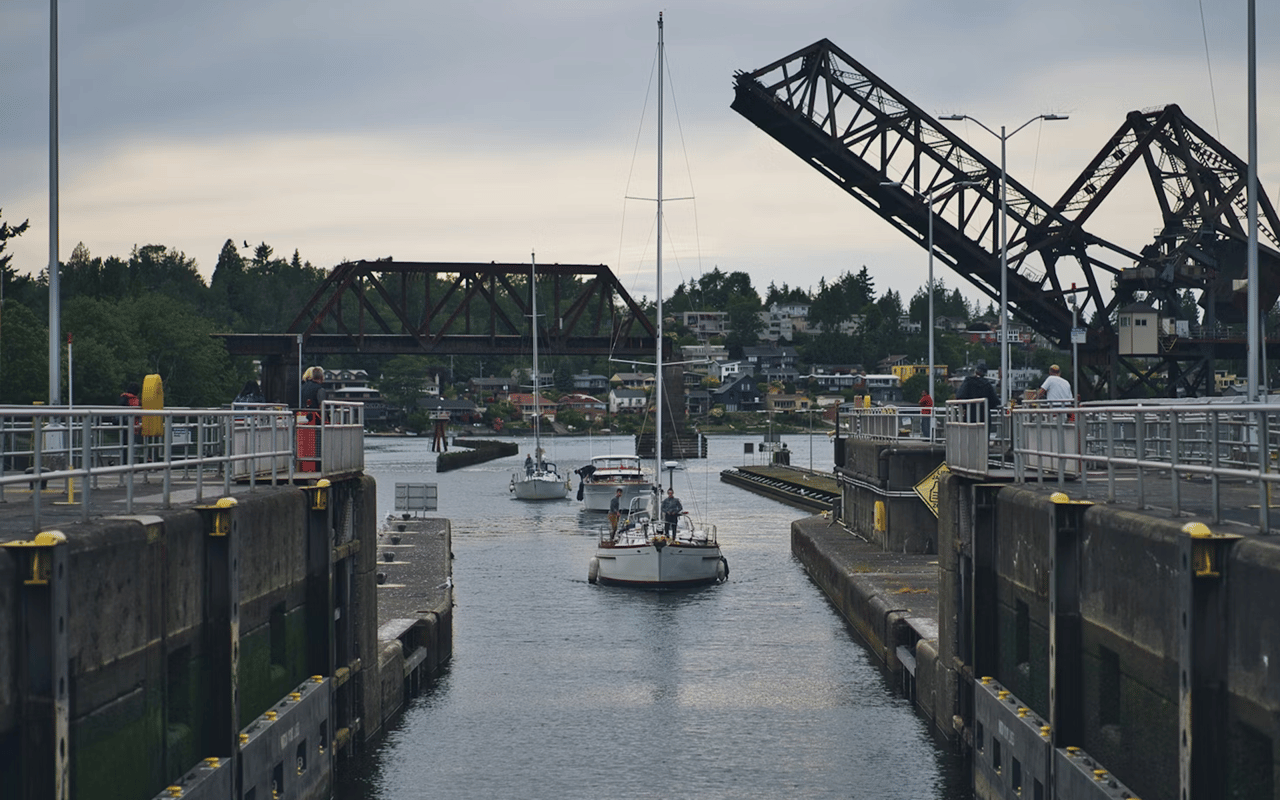
Seattle has no shortage of landmarks worth knowing, but few capture the imagination quite like the Hiram M. Chittenden Locks. Officially called the Lake Washington Ship Canal Locks, locals simply refer to them as "the Ballard Locks.” This engineering marvel connects Puget Sound's saltwater with the freshwater of Lake Union and Lake Washington, making it one of the most active waterway locks in the entire United States — and one of Seattle's most compelling destinations to spend an afternoon.
If you're considering a move to this corner of northwest Seattle, the Locks offer a window into what makes this setting so distinct. It's not just the industrial romance of boats rising and falling; it's the waterfront park, the fish ladder, the botanical gardens on site, and the particular feeling of standing at a place where the city's working history is still actively and visibly alive.
Key Takeaways
- The Ballard Locks connect Puget Sound to Lake Union and Lake Washington via the Lake Washington Ship Canal and are among the busiest locks in the country.
- Visitors can watch boats of all sizes navigate the locks, observe salmon migrating through the on-site fish ladder, and explore the adjacent Carl S. English Jr. Botanical Garden.
- The Locks are free to visit and open to the public year-round, making them a beloved community anchor.
How the Ballard Locks Work
The Hiram M. Chittenden Locks opened in 1917 after years of construction under the Army Corps of Engineers. The project's core purpose was to stabilize the water levels of Lake Union and Lake Washington while creating a navigable passage between those freshwater lakes and the tidal saltwater of Puget Sound. Before the locks existed, that connection simply didn't exist in any practical form. The construction of the Ship Canal fundamentally changed how Seattle could use its waterways.
The locks themselves consist of two parallel chambers: a large lock and a smaller one. When a boat needs to move from the salt water of the Sound into the freshwater canal system, it enters the lock chamber, the gates close behind it, and water is either added or drained to raise or lower the vessel to the appropriate level. The difference between the tidal level of Puget Sound and the controlled level of Lake Washington can be anywhere from six to twenty-six feet, depending on the tides, which means that every transit through the locks is a small feat of hydraulic engineering.
On a busy summer weekend, the operation runs almost continuously. Recreational boats, commercial fishing vessels, research ships, and kayaks (yes, there's a small lock for human-powered craft) all take their turns. Standing on the observation area above the locks, you get an unusually close-up view of Seattle's working waterfront — a side of the city that most visitors and even many residents rarely encounter.
What To Know Before You Visit
- Admission is free, and the grounds are open daily from 7 a.m. to 9 p.m., with the locks themselves operating around the clock. Daily tours are offered in the afternoon.
- The best time to watch heavy boat traffic is summer weekends, particularly on sunny afternoons when recreational boaters are most active.
- The fish ladder viewing windows are open seasonally and allow you to watch salmon and steelhead migrating upstream through a series of stepped pools.
- The Carl S. English Jr. Botanical Garden on the grounds features seven acres of exotic trees and plant species and makes for a relaxing walk.
The Fish Ladder: A Quieter Kind of Engineering
Alongside the main locks, the U.S. Army Corps of Engineers built a fish ladder to allow salmon and other anadromous fish to migrate upstream into Lake Washington and beyond. Without it, the locks would have been an impassable barrier for species that spend part of their life cycle in the ocean and return to freshwater to spawn.
The 21-step fish ladder consists of a series of stepped pools that allow fish to travel upstream in manageable increments rather than attempting a single impossible leap. What makes the Ballard fish ladder particularly compelling as a visitor experience is the underground viewing gallery. You can stand at a window and watch sockeye, Chinook, coho, and steelhead actively moving through the water just inches away. The peak migration period runs roughly from late June through November, and during those months, the viewing windows can be mesmerizing — schools of salmon holding position in the current, gathering themselves before the next push upstream.
Fish Migration Timing at the Locks
- Sockeye salmon typically peak from late June through early August.
- Chinook salmon begin arriving in July and continue through September.
- Coho salmon run from September through November.
- Steelhead trout can be spotted from December through April.
The Botanical Garden and the Grounds
The Carl S. English Jr. Botanical Garden occupies roughly seven acres of the grounds and has been cultivated since the early 1900s, when the locks were first built. English, a horticulturist who worked for the Army Corps of Engineers, spent decades collecting and planting specimens from around the world, and the garden reflects that patient, eccentric dedication.
The design is deliberately informal — more of a rambling English garden style than a formal landscape — with winding paths, mature trees that provide generous shade, and plant labels that turn a walk into a low-key learning experience. In spring, the flowering trees and shrubs are particularly striking. On a clear day, the combination of blooms, canal views, and distant mountains creates a scene that's exceptionally photogenic, even by Seattle standards.
Garden Highlights by Season
- Spring brings flowering cherries, magnolias, and ornamental shrubs with color that peaks in April and May.
- Summer offers full green canopy coverage, making the grounds a comfortable shaded retreat even on warm days.
- Fall brings foliage color and the peak of the salmon migration season, making it arguably the most rewarding time to visit.
- Winter is quiet but still worth exploring; the canal and lock operations continue year-round regardless of weather.
FAQs
What Are the Ballard Locks, and Why Are They Significant?
The Ballard Locks, also known as the Hiram M. Chittenden Locks, are a set of navigational locks on the Lake Washington Ship Canal in Seattle. They connect the saltwater of Puget Sound with the freshwater of Lake Union and Lake Washington and are operated by the U.S. Army Corps of Engineers. The locks handle an enormous volume of boat traffic annually and serve as one of Seattle's most enduring examples of early 20th-century civil engineering. They're significant not just as infrastructure but as a living piece of the city's maritime history.
When Is the Best Time to Visit the Ballard Locks?
Any time of year offers something worth seeing, but summer and early fall tend to be the most active and rewarding. Summer brings heavy recreational boat traffic, long daylight hours, and the botanical garden in full bloom. Early fall overlaps with the peak salmon migration season at the fish ladder, which is a compelling spectacle. Weekday mornings offer a quieter experience if you prefer to avoid crowds.
Seattle's Best-Kept Secret Isn't Really a Secret
The Ballard Locks have been a working part of Seattle since 1917, and more than a century later, they remain one of the most interesting places in the city to spend time. There's a reason longtime Seattleites still bring out-of-town visitors here and a reason buyers who discover the city tend to stay.
Our team knows Seattle real estate in detail and would be glad to walk you through what the market looks like and what ownership actually means on a day-to-day basis. Reach out to our team at Ensemble when you're ready to take the next step.